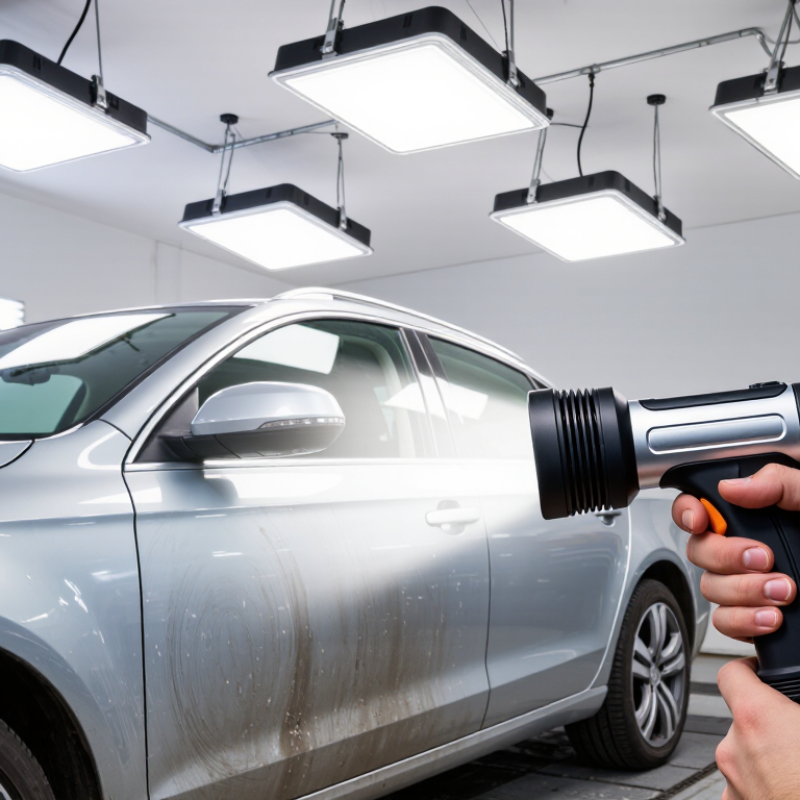
Choosing the right inspection light can change how accurately a detailer sees paint defects, dust, and uneven polish. Fixed lights provide consistent coverage, but they often leave blind spots around mirrors, wheel arches, and lower panels. Handheld inspection lights move with the technician, making it easier to examine reflections from several angles. This flexibility matters when a faint swirl appears only under a narrow beam.
So, why do detailers prefer handheld inspection lights over fixed lights? The answer usually involves control, portability, and faster decisions. A detailer can hold the light close to a door edge, adjust its angle, and compare the finish beside a bright window. Many professional models also offer adjustable color temperature, rechargeable batteries, and high color-rendering performance. These features help reveal differences between factory paint, compound haze, and remaining contamination. However, specifications alone do not guarantee useful results. A very powerful beam may create harsh glare and hide subtle defects.
In practice, experienced technicians often combine both lighting types. A fixed system can illuminate the work bay evenly, while a handheld light supports close inspection before delivery. The best choice depends on workshop size, surface color, battery life, and the detailer’s working habits. I have found that a comfortable grip can matter as much as brightness after several hours of inspection. That point is easy to overlook. No light replaces careful panel preparation, clean lenses, and a trained eye. Even reliable tools can produce misleading impressions when used from only one angle. This guide explains how to evaluate beam control, portability, color accuracy, durability, and practical value before choosing handheld inspection lights over fixed lights.
How to Choose Handheld Inspection Lights Over Fixed Lights
Choosing between handheld and fixed inspection lights starts with their physical roles. A handheld light travels with the technician. It can illuminate a weld, cable joint, or dark recess from several angles. Fixed lights remain mounted above a bench, inside a cabinet, or beside a production line. Their position stays consistent, supporting repeatable viewing and reducing hand fatigue. That difference matters more than brightness alone. A powerful beam is not useful if it creates glare on polished metal. Small detail.
Handheld models offer flexibility during maintenance, fault tracing, and inspections across large equipment. The user can change distance, angle, and beam direction within seconds. However, one hand may hold the light while the other handles a gauge or tool. Dropping it is also possible. Fixed lights suit repeated inspections at a known workstation. They keep both hands free and can provide broad, even coverage. Yet their reach is limited. A poorly placed unit may leave shadows behind brackets or inside narrow housings.
In practice, I compare mounting, power access, heat, beam spread, and cleaning requirements before choosing. A rechargeable handheld light may be convenient, but its battery condition needs checking before every shift. A fixed unit may be dependable, but installation can take time. Equipment changes may also require repositioning. I once favored fixed lighting for consistency, then found that angled surfaces still needed a movable source. The better choice depends on inspection movement, workspace geometry, and how repeatable the viewing task really is.
| Evaluation Dimension | Handheld Inspection Lights | Fixed Inspection Lights | Selection Guidance |
|---|---|---|---|
| Primary Use | Detailed checks across vehicles, machinery, assemblies, and hard-to-reach areas. | Continuous illumination of a defined workstation, inspection station, or production line. | Choose handheld lighting for mobile inspections; choose fixed lighting for repeatable, stationary tasks. |
| Mobility | Can be carried, repositioned, or aimed at different surfaces during an inspection. | Remains attached to a wall, ceiling, machine, bench, or other mounting point. | Prioritize handheld models when inspection locations or viewing angles change frequently. |
| Power Source | Usually powered by rechargeable or replaceable batteries; operating time depends on output and battery capacity. | Commonly connected to mains power or a permanently installed low-voltage supply. | Use battery-powered lights where cables restrict movement or where no outlet is nearby. |
| Typical Operating Time | Often several hours per charge, depending on brightness, battery size, and operating mode. | Designed for extended or continuous operation while connected to a power source. | Select fixed lights for long shifts without battery changes; verify handheld runtime for the intended task. |
| Illumination Pattern | Often offers a focused beam, flood beam, or adjustable beam for close-up viewing. | Usually provides a broad, consistent light field over a predetermined work area. | Choose the beam pattern according to whether the task requires detail, coverage, or both. |
| Brightness Control | Many models provide multiple output levels, helping reduce glare and conserve battery power. | May use a wall switch, dimmer, or lighting control system, depending on the installation. | Variable brightness is useful when surfaces are reflective or inspection conditions change. |
| Color Quality | LED models commonly offer neutral or cool white light; color-rendering performance varies by model. | Can be specified with a consistent color temperature and color-rendering level across a workstation. | For paint, wiring, labels, and surface defects, check the stated color-rendering specification. |
| Installation | Requires little or no installation and can be used immediately after charging or battery insertion. | Requires mounting, positioning, electrical connection, and sometimes professional installation. | Handheld lights are generally better for temporary work areas or changing layouts. |
| Access to Tight Spaces | Can be placed close to components and directed into narrow or obstructed spaces. | Coverage may be limited by the fixed mounting position and surrounding structures. | Select a compact handheld light for engines, cabinets, ducts, cavities, and underside inspections. |
| Hands-Free Operation | Hands-free use may require a magnetic base, clip, hook, head strap, or separate support. | Naturally leaves both hands available once correctly positioned. | For frequent two-handed work, consider a fixed light or a handheld model with a secure mounting option. |
| Durability and Protection | Should be checked for impact resistance, ingress protection, lens strength, and grip design. | Usually experiences less handling impact but must be suitable for dust, moisture, heat, or chemicals at the installation site. | Match the protection rating and construction to the actual inspection environment. |
| Maintenance | Requires charging, battery replacement, lens cleaning, and periodic inspection for damage. | Requires cleaning, electrical checks, mounting inspection, and replacement of light sources or components when needed. | Consider battery-management time for handheld units and installation-access time for fixed units. |
| Best Choice When | The inspection is mobile, close-up, variable, or performed in confined spaces. | The inspection is repetitive, stationary, continuous, and centered on one defined work area. | Base the final decision on movement, runtime, mounting needs, required coverage, and workplace conditions. |
Note: Performance varies by product design and operating conditions. Check the manufacturer’s specifications for lumen output, battery runtime, color-rendering performance, impact resistance, and ingress protection before purchase.
Choose handheld lighting when inspections move between cabinets, pipes, gaps, and machine interiors. It follows the technician. Fixed lights suit predictable workstations.
Use a narrow beam for deep cavities. Choose wider, softer light for polished panels or uneven paint. Test both angles on the real surface.
Accurate color helps reveal coating changes, wiring details, stains, and subtle damage. Brightness alone can hide important differences.
Ordinary work may need about 200 lux. Detailed tasks may need about 500 lux. These are references, not automatic answers.
Not always. A bright beam can reflect from metal and create glare. Move the light, lower brightness, or widen the beam.
Check grip comfort, heat, impact resistance, sealing, beam adjustment, and switch protection. A small light should not become tiring after twenty minutes.
Compare runtime at normal working brightness, not maximum claims. Match it to the inspection route. Recharging delays can disrupt night work.
Usually, initial costs are lower. However, include batteries, chargers, repairs, storage, and replacement time. Frequent drops may change the decision.
Loose cables, weak batteries, heat, glare, and dropped equipment can create hazards. Review conditions near moving machinery or electrical equipment carefully.
Yes. Place it beside the actual workpiece. Check shadows, glare, heat, handling effort, and defect visibility. Specifications can mislead.
Choosing between handheld and fixed inspection lights depends on the work being performed, the workspace, and the level of lighting control required. Fixed lights provide consistent illumination in a permanent position, making them useful for stable workstations and repeated inspection routines. Handheld lights, however, can be moved, angled, and directed toward difficult areas, making them more practical for vehicles, machinery, interiors, and detailed surface checks. When considering why do detailers prefer handheld inspection lights over fixed lights, the main reasons are portability, flexible positioning, and the ability to inspect shadows, edges, and uneven surfaces from multiple angles.
The best inspection light should offer suitable brightness, controlled beam coverage, dependable battery power, and durable construction for regular use. It should also be comfortable to hold and easy to position without interrupting the task. While fixed systems may be efficient for dedicated spaces, handheld options often provide greater versatility and lower installation demands. By balancing safety, purchase cost, maintenance, and long-term performance, users can select lighting that improves visibility and supports accurate, efficient inspections.

 Xolle Light