Choosing geometric LED lights for a garage involves more than selecting an attractive ceiling pattern. The right system must improve visibility, reduce shadows, and withstand dust, vibration, and temperature changes. This is why many homeowners ask, “why are geometric led lights so popular for garages?” Their modular hexagonal or linear designs spread light across workbenches, vehicle bays, and storage corners. The result feels brighter and more organized than a single central fixture.
Michael Royer, a lighting researcher associated with Pacific Northwest National Laboratory, explains, “Lighting quality is more than simply producing light.” That principle matters in garages. A fixture can advertise high lumens yet create harsh glare or dark areas beneath shelving. Good selection requires checking beam distribution, color temperature, color rendering, energy use, and installation quality. A 4000K to 5000K appearance often supports detailed mechanical work without feeling excessively blue. High CRI performance can also help reveal paint colors, wiring labels, and oil leaks more accurately.
Details matter. Measure the ceiling first. Mark each panel around doors, lifts, and benches. Confirm the circuit capacity and follow local electrical requirements. Dust-resistant construction is useful, but a higher rating does not solve poor placement. I have seen attractive layouts leave shadows beside open car doors. That is easy to overlook. It deserves reconsideration. The best geometric LED system balances visual impact with dependable performance, comfortable brightness, and practical maintenance. A clean pattern is valuable, but useful light remains the real goal.
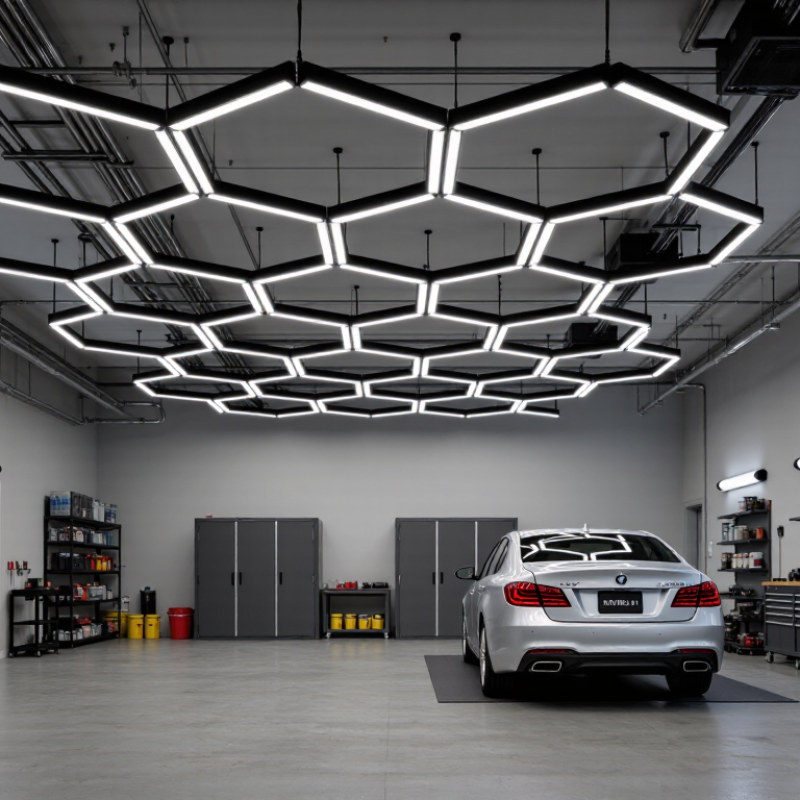
Geometric LED lights are modular fixtures arranged in hexagons, triangles, or repeating lines. They create a bright, patterned ceiling rather than a single pool of light. In a garage, this layout can reduce dark areas around workbenches, shelves, and parked vehicles. The design is practical, not only decorative.
From my experience, even lighting makes small repairs easier and reduces eye strain. Look for a suitable lumen output, a color temperature around 4000K to 5000K, and a high color rendering index. Accurate color matters when checking paint, wiring, or fluid leaks. Choose diffused covers to limit glare on polished car surfaces. Dust-resistant construction is also useful in active garages.
Installation deserves careful attention. Measure the ceiling before choosing a pattern, and keep panels clear of doors, storage racks, and ventilation equipment. Connect the system to a properly rated power supply. I once positioned a bright panel directly above a workbench, only to discover strong reflections on metal tools. The light was powerful, but the placement was wrong. That mistake changed how I judge garage lighting: brightness alone is not enough. Some geometric systems also need more ceiling space than expected, especially when access panels or uneven surfaces interrupt the pattern.
Assess the garage before choosing geometric LED lights. Measure its length, width, and ceiling height. A single-car garage may need 3,000 to 5,000 lumens, while a deeper workshop often needs more. These figures are practical starting points, not fixed rules. Dark walls and stored equipment absorb light. Pale surfaces reflect it more effectively.
Sketch the layout, including vehicles, shelves, benches, and doors. Place geometric LED panels above work areas, not only in the room’s center. Connected hexagonal or linear shapes can create broad coverage, but tight patterns may leave corners dim. Keep fixtures clear of garage doors and tall storage units. Check the beam spread and mounting method before drilling. Measure twice.
Color temperature also affects usability. Neutral white light around 4,000K to 5,000K supports general parking and cleaning. Cooler light near 5,000K can reveal small marks during repairs, although it may feel harsh. A high color rendering index helps distinguish wire colors, paint shades, and oil stains. Dust is easy to overlook. Choose fixtures suited to the garage’s moisture and dust conditions, and ask a qualified electrician to verify the circuit load. My first layout would not be perfect; shadows from open shelving can still appear. Test one section at night before installing the full pattern.
| Garage Profile | Typical Dimensions | Floor Area | Recommended Illuminance | Approx. Installed Lumens | Recommended Geometric Layout | Selection Notes |
|---|---|---|---|---|---|---|
| Compact single-car garage | 18 ft × 20 ft (5.5 m × 6.1 m) |
360 sq ft (33.4 m²) |
300 lux (28 foot-candles) |
14,000–16,000 lm | One centered hexagon or two parallel linear runs | Use a compact pattern to preserve clearance around the vehicle and storage walls. |
| Standard single-car garage | 20 ft × 22 ft (6.1 m × 6.7 m) |
440 sq ft (40.9 m²) |
300 lux (28 foot-candles) |
17,000–20,000 lm | Two or three balanced geometric sections with a central axis | Center the pattern over the usable floor area rather than directly over wall-mounted cabinets. |
| Standard two-car garage | 24 ft × 24 ft (7.3 m × 7.3 m) |
576 sq ft (53.5 m²) |
300 lux (28 foot-candles) |
22,000–26,000 lm | Large hexagonal grid or two mirrored geometric clusters | Split the layout into zones so each vehicle bay receives even illumination. |
| Two-car garage with workshop area | 24 ft × 30 ft (7.3 m × 9.1 m) |
720 sq ft (66.9 m²) |
300 lux general; 500 lux at workbench |
28,000–34,000 lm | Geometric grid for vehicle bays plus a separate linear task-light zone | Provide dedicated task lighting near tools; general ceiling lighting alone may create shadows at the bench. |
| Large three-car garage | 30 ft × 30 ft (9.1 m × 9.1 m) |
900 sq ft (83.6 m²) |
300 lux (28 foot-candles) |
35,000–42,000 lm | Three repeated geometric modules or a full-room hexagonal grid | Use symmetrical spacing and separate switching for parking, storage, and work areas. |
| High-ceiling service garage | 30 ft × 40 ft (9.1 m × 12.2 m) |
1,200 sq ft (111.5 m²) |
300–500 lux | 47,000–70,000 lm | Long linear geometric rows arranged perpendicular to work positions | For ceilings above 12 ft, select higher-output fixtures and verify the beam distribution to limit dark areas. |
Shape affects coverage more than decoration. Hexagonal layouts spread light across wide ceilings, reducing dark gaps between vehicles. Linear bars suit narrow garages and workbenches because they guide light along the working direction. Square or diamond modules can look balanced, but their corners may leave shadows near shelves. In real installations, a perfectly symmetrical pattern is not always practical. Door tracks, storage racks, and ceiling beams interrupt the geometry.
Brightness should match the task. The Illuminating Engineering Society commonly associates parking areas with roughly 50–100 lux, while detailed mechanical work may require about 300–500 lux. The U.S. Department of Energy’s 2023 Solid-State Lighting R&D Opportunities report notes that laboratory LED efficacy can exceed 200 lumens per watt. Actual fixtures produce less after optics, heat, and installation losses. For a typical home garage, aim for even output rather than the highest lumen number. Excessive brightness can create glare on polished metal.
Color temperature changes how the space feels. Around 3500K–4000K offers a comfortable appearance for storage and routine parking. Around 5000K improves contrast for tools, wiring, and engine parts. The IES Lighting Handbook generally supports high color rendering for visual tasks, so choose at least CRI 80, preferably CRI 90 near workbenches. I would not use 6500K automatically. It can feel harsh, especially on bare concrete, and personal comfort still matters. Test one fixture first.
Geometric LED lights can make a garage brighter, but installation method affects long-term performance. Surface-mounted panels suit low ceilings and concrete surfaces. They require fewer suspension parts and keep wiring protected. Suspended systems spread light across taller garages, yet cables must be anchored carefully. Always check junction-box locations before drilling. A neat pattern can still create dark workbench corners.
Controls deserve equal attention. Occupancy sensors can reduce wasted lighting in empty areas, although detection may fail behind vehicles or storage racks. Choose adjustable time delays and include a manual override. Daylight sensors can dim fixtures near windows, but dusty windows and changing sunlight reduce accuracy. The U.S. Department of Energy reports that occupancy controls commonly save 10% to 50% of lighting energy, depending on use and settings. That range is wide. Real savings need measurement.
Compare fixtures by delivered lumens per watt, not advertised wattage alone. The DOE states that LED lighting uses at least 75% less energy than incandescent lighting and lasts up to 25 times longer. For garages, also check standby power, driver compatibility, color rendering, and flicker performance. The International Energy Agency identifies lighting as a major electricity-use category worldwide, making small efficiency gains meaningful. My practical caution is simple: a low-cost sensor can undermine an efficient fixture if it switches too slowly. Record monthly operating hours before and after installation. Numbers expose assumptions.
How to Choose Geometric LED Lights for Garages?
Safety should guide every geometric LED light choice, not just brightness. In practice, I have found that a bright fixture can still create harsh glare and dark corners. Check the product’s electrical safety certification and confirm its rating suits the garage environment. Damp or unheated garages need stronger protection against moisture. Review flicker performance, especially if tools, fans, or rotating equipment operate nearby. Excessive flicker can cause visual discomfort and may reduce concentration. The U.S. Department of Energy reports that LED lighting uses at least 75% less energy and can last up to 25 times longer than incandescent lighting (DOE, LED Basics). Those figures are useful, but actual life depends on heat, installation, and operating hours.
Durability begins with the enclosure and driver. IEC 60529 defines IP ratings for protection against dust and water, so compare the rating with your garage’s humidity and cleaning conditions. Look for stable mounting, impact-resistant covers, and heat dissipation through metal housing or ventilation. Cheap plastic may yellow or crack. It happens. Check the rated lifetime, warranty terms, replacement parts, and connector quality. Maintenance should be simple: power off before cleaning, wipe the diffuser with a dry microfiber cloth, and inspect dark spots, loose wiring, or discoloration. I would not rely on lumen claims alone; independent photometric reports and measured flicker data are more trustworthy. A technically perfect layout can still fail if the panels are difficult to reach. Geological shapes are attractive, but access matters.
They are modular panels arranged in hexagons, triangles, or repeating lines. This creates patterned ceiling lighting. The layout can reduce shadows near shelves, vehicles, and workbenches.
Even light makes small repairs easier and can reduce eye strain. It helps reveal paint differences, wiring colors, and fluid leaks. A bright center is not enough.
Choose about 4000K to 5000K for a clear, neutral appearance. A high color rendering index helps show accurate colors. This matters when inspecting cables or painted surfaces.
Use diffused covers instead of exposed light sources. Place bright panels carefully above work areas. Metal tools and polished car panels can reflect harsh light.
Surface-mounted panels usually suit low ceilings and concrete surfaces. They need fewer suspension parts. Suspended systems may suit taller garages, but their cables require secure anchors.
Mark doors, storage racks, ventilation equipment, and access panels. Keep the lighting pattern clear of moving or serviceable areas. Measure twice. A neat pattern can still leave dark workbench corners.
Occupancy sensors can reduce wasted lighting in empty areas. Vehicles or storage racks may block detection. Use adjustable delays and include a manual override. Daylight sensors can become less accurate through dusty windows.
Compare delivered lumens per watt, standby power, color rendering, and flicker performance. Record monthly operating hours before and after installation. Numbers expose assumptions. A cheap sensor may weaken an efficient lighting system.
Confirm electrical safety certification and suitability for damp or unheated spaces. Check dust and moisture protection, secure mounting, impact resistance, and heat dissipation. Review the rated lifetime, warranty, connectors, and replacement parts. Cheap plastic may yellow or crack.
Turn off power before cleaning. Wipe diffusers with a dry microfiber cloth. Inspect dark spots, loose wiring, discoloration, and damaged covers. A beautiful layout fails if panels are difficult to reach.
Geometric LED lights are modular lighting systems made from connected shapes such as hexagons, triangles, or lines, creating both practical illumination and a modern visual effect. The question “why are geometric led lights so popular for garages” can be answered by their wide coverage, customizable layouts, strong brightness, and stylish appearance. Before choosing a design, assess the garage’s size, ceiling height, work areas, storage zones, and the amount of natural light available. Larger spaces or detailed workstations may require more panels and higher lumen output, while smaller garages can benefit from a simpler arrangement.
Consider the shape and layout that best match the space, along with a color temperature that supports visibility without causing glare. Installation options may include surface mounting, adhesive systems, or suspended setups, depending on the ceiling and electrical access. Adjustable controls, motion sensors, and energy-efficient operation can improve convenience and reduce unnecessary consumption. Finally, check for durable construction, safe wiring, heat resistance, easy cleaning, replaceable components, and reliable maintenance access to ensure long-term performance.

Xolle Light